

Residential EV Charging Station Installation in South Jersey
Charging an electric vehicle at home should be simple — plug in overnight, wake up to a full battery. But getting there safely requires more than a trip to the hardware store. Professor Gatsby’s Heating, Cooling, Plumbing and Electric installs Level 2 EV charging stations for homeowners throughout the South Jersey area, from panel assessment through final inspection.
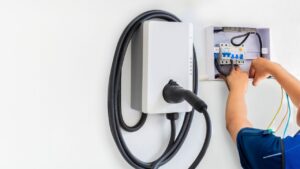
Level 1 vs. Level 2 Charging
Level 1 charging uses a standard 120-volt household outlet — the same type your everyday appliances use. It works, but slowly, typically adding only 3–5 miles of range per hour. For most drivers, that’s not enough to reliably charge overnight.
Level 2 charging uses a dedicated 240-volt circuit, delivering 20–40 miles of range per hour depending on your charger and vehicle. A full charge typically takes just a few hours instead of an entire day — which is why most EV owners who install home charging choose Level 2 and don’t look back.
What a Level 2 Installation Requires
- A dedicated 240-volt circuit, separate from any other household circuits
- A properly sized breaker — most Level 2 chargers need a 40- to 60-amp circuit, sized to code at 125% of the charger’s continuous load
- Correctly gauged wiring run from your panel to the charging location
- Either a hardwired connection or a dedicated NEMA 14-50 outlet, depending on the charger and your preferences
- Sufficient panel capacity to support the new circuit alongside your home’s existing electrical load
A note on shortcuts: plugging a Level 2 charger into an existing dryer outlet might seem convenient, but dryer outlets aren’t built for the continuous, high-power draw of daily EV charging, and doing so can create real safety and code issues. A dedicated circuit, sized and installed specifically for the charger, is the safe approach.
Does Your Panel Have Enough Capacity?
This is the question that determines the whole project. Most homes run on 100-amp or 200-amp electrical service:
- 200-amp panels can usually accommodate a Level 2 charger circuit without further upgrades, assuming there’s room left after accounting for your home’s other major loads (HVAC, electric range, etc.)
- 100-amp panels can sometimes support a charger, but often require a panel upgrade first — especially in homes that already run central air, an electric dryer, or other high-demand appliances
- Older or smaller-service panels (60-amp) will almost always need an upgrade before EV charging can be added safely
Rather than guessing, our electricians perform a load calculation on your actual panel and household usage to determine exactly what your home can support — and recommend a panel upgrade only if it’s genuinely needed.
Hardwired vs. Plug-In Chargers
Hardwired installation connects the charger directly into your electrical system with no outlet in between. It’s generally the more stable option, avoids added GFCI complications, and is required by some charger models at higher amperages.
Plug-in installation uses a NEMA 14-50 outlet, giving you the flexibility to unplug and relocate the charger if needed. Many local codes now require GFCI protection on these outlets, which our electricians account for during installation to avoid nuisance tripping.
We’ll walk you through which option fits your charger, your garage layout, and your preferences.
Choosing a Charger & Location
We help you select the right charger for your vehicle and driving habits, then plan the installation location for the shortest, safest wiring path — typically close to where you regularly park. For outdoor or detached garage installations, we account for weatherproofing and, when necessary, trenching for underground wiring runs.
What Installation Involves
- Panel assessment & load calculation – We evaluate your existing panel capacity and household electrical load.
- Charger & location planning – We help you choose the right charger and the best mounting location.
- Circuit installation – We run a dedicated 240-volt circuit from your panel to the charging location, sized and wired to code.
- Charger installation – Hardwired connection or NEMA 14-50 outlet, installed and secured per manufacturer specifications.
- Permits & inspection – EV charger circuits require a permit in most jurisdictions — we handle the paperwork and inspection process.
- Testing – We verify proper charging performance before we consider the job done.
Why This Isn’t a DIY Project
Level 2 EV charging involves high-voltage, continuous-load circuits — a different category of electrical work than a typical outlet or fixture. Incorrect installation can trip breakers, damage your vehicle’s charging system, void your charger’s warranty, or create a genuine fire hazard. Most jurisdictions also require a permit and inspection, and unpermitted work can create issues with insurance and home resale down the line.
Why Choose Professor Gatsby’s
- Licensed electricians experienced in EV charger load calculations and installation
- Honest assessment of whether your panel needs an upgrade — or doesn’t
- Support for hardwired and plug-in installations, indoor and outdoor
- Full permitting and code-compliant work
- One trusted company for your electrical, heating, cooling, and plumbing needs
Serving All of Southern New Jersey
Whether you’re prepping for your first EV or adding a second charger for a growing household, Professor Gatsby’s can get your home ready for safe, reliable overnight charging.
Ready to charge at home? Contact Professor Gatsby’s today to schedule an EV charger consultation.
Our South Jersey Locations
Williamstown, New Jersey Office
(856) 315-0007
Berlin, New Jersey Office
(856) 315-1651
Trenton, New Jersey Office
(609) 308-7655