Heating oil prices are climbing again this winter. The U.S. Energy Information Administration’s October outlook projects heating oil prices more than 30 percent above last winter, with household spending on oil up about 21 percent. Homes heated with natural gas are expected to pay less than last winter. If you are searching “convert oil to gas NJ” for the first time, here are the answers in the order most homeowners ask them: Is gas available on my street? What does it cost? What happens to my oil tank? Furnace or boiler? And what does the process look like?
The short answer: If natural gas is available at your address, switching from oil is often worth it, especially if your oil system is 15 years old or older. If gas is not available yet, the cost and timeline change, and a heat pump may be the better option.
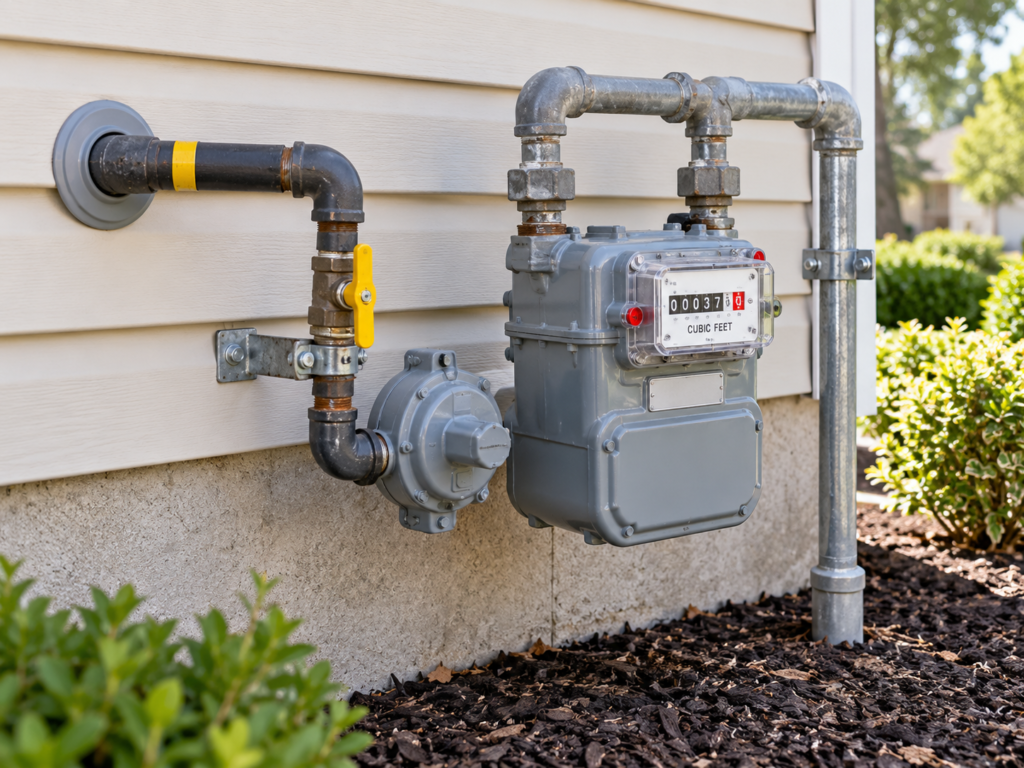
1. Is Gas Available on My Street?
Everything depends on this. It decides how simple and how expensive your conversion will be.
Can I get gas? Checklist:
- Is there a gas meter on the outside of your home? If yes, you have service, and your conversion is usually a straightforward equipment swap.
- Do you already cook or dry clothes with natural gas? If yes, you already have a gas line.
- Do neighbors on your street have gas meters? If yes, there is probably a gas main nearby.
- Is there a gas main on your street, but your home is not connected? Then the utility needs to run a service line from the street to your house.
- No gas on your street at all? Then the utility would need to extend a main, which costs more and takes longer. Ask the utility whether it is possible and what it would cost.
How to check with your gas utility. In South Jersey, your gas utility is most likely South Jersey Gas, which serves Atlantic, Burlington, Camden, Cape May, Cumberland, Gloucester and Salem Counties. PSE&G supplies gas in some Camden, Gloucester and Burlington County towns. Availability varies by street, so check your own address:
- South Jersey Gas: call 1-888-637-2854 to ask whether gas is available at your address. An account manager can schedule a visit to price the service line and meter.
- PSE&G: email switchtogas@pseg.com or use the Gas Service Map on its website. A specialist replies within about two business days.
Not sure which utility serves you? Look at your electric or neighbors’ meters, or call us and we will help you find out.
2. How Much Does It Cost to Convert From Oil to Gas?
The total depends on the new equipment, the gas line work and removing the old oil system. Here is what goes into the price.
Cost factor | What it covers | Typical cost |
New gas furnace (high-efficiency) | Equipment and installation | About $6,900 to $12,500 |
New gas boiler (condensing) | Equipment and installation | About $6,300 to $18,800 (average near $10,600) |
Gas service line and meter | Utility connection from the street to your home | South Jersey Gas says it installs the service line and meter free of charge in most cases. PSE&G estimates the cost for each home. |
Gas piping and venting | Gas lines inside the home, new venting or chimney liner | Depends on distance and layout. Included in your quote. |
Removing the old oil equipment | Disconnecting and removing the oil furnace or boiler | Usually included in a conversion quote. |
Oil tank removal | Above-ground or buried tank | See Section 3. |
Permits and inspections | Plumbing, gas and utility inspections | Included in your quote. |
Typical total: Most conversions fall somewhere between about $8,000 and $20,000, depending on the system you choose, how far the gas line has to run and how complicated the installation is. That does not include buried tank cleanup if a leak is found. This range is an estimate. Your quote will be exact.
What does it save? Natural gas is usually about 30 to 50 percent cheaper than heating oil for the same home. A common estimate for an average home is about $1,200 to $2,400 per season for gas, versus $2,000 to $3,500 for oil. With oil prices jumping, the gap is wider this winter.
Payback example (illustrative): Say you spend $3,500 a year on oil and would spend about $2,000 on gas. You would save about $1,500 a year. On a $12,000 project, the payback is about 8 years. Higher oil prices, utility rebates and the cost of an aging oil tank you would otherwise replace can shorten that. Plug your own numbers into the same math: net project cost divided by yearly savings.
Rebates and financing. South Jersey Gas advertises up to $1,750 in rebates and financing as low as 0% APR on high-efficiency gas furnaces and boilers. PSE&G also offers rebates on qualifying high-efficiency equipment. Eligibility rules vary, so ask whether your conversion qualifies before you sign.
3. What Happens to My Oil Tank?
When you switch to gas, your oil tank is no longer needed. What it costs to deal with depends on where it is.
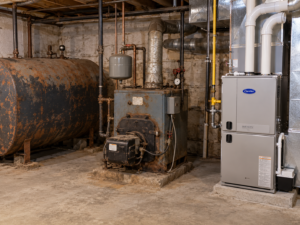
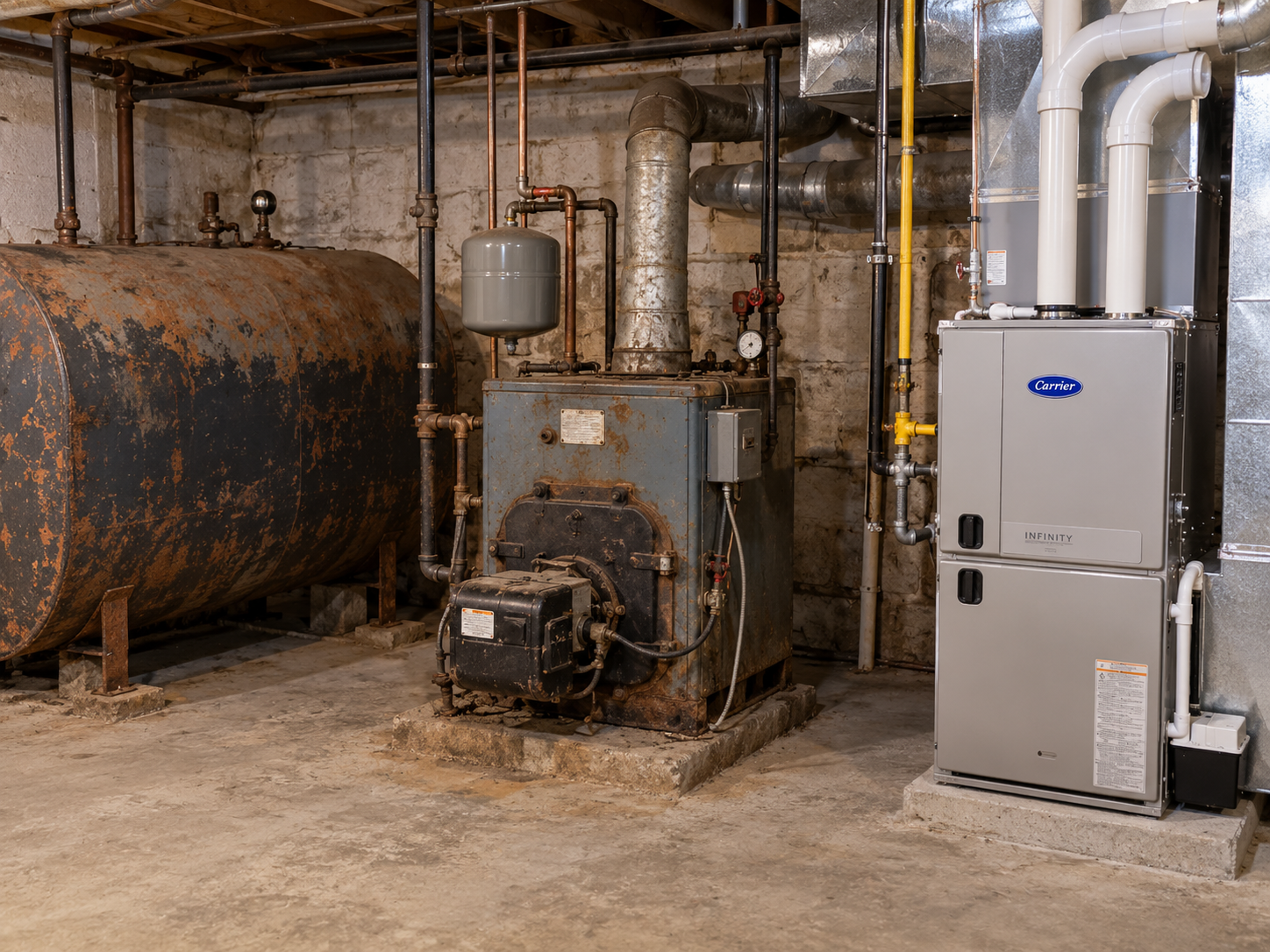
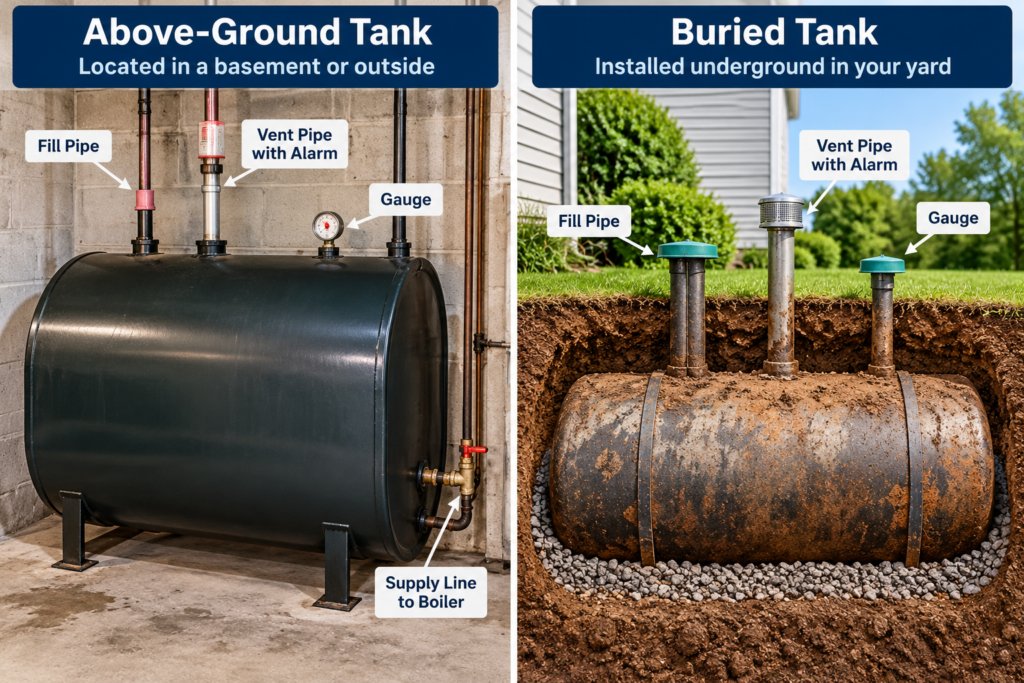
Above-ground tanks (usually in a basement, garage or utility room) are the simpler case. The oil is pumped out, the tank is cleaned and the tank is cut up and removed. Removal typically costs about $500 to $1,000.
Buried (underground) tanks cost more and carry more risk. A buried tank has to be excavated, cleaned and removed or properly closed. Typical removal runs about $1,500 to $3,000 or more. For reference, the New Jersey DEP’s Underground Storage Tank Fund uses flat rates of about $1,500 for a tank of 550 gallons or less and $2,100 for 1,000 gallons for non-leaking residential tanks. Those rates include excavation, cleaning, removal and disposal.
What can raise the cost:
- A leaking tank. Contaminated soil has to be tested and cleaned up, which can add substantially to the cost.
- Hard access, such as a tank under a driveway, patio or finished space.
- Tank size.
Who removes it? In New Jersey, underground tank work has to be done by certified contractors. Ask your HVAC contractor whether tank removal is included or coordinated. Do not leave a buried tank in the ground without understanding the rules and your options, because an abandoned tank can cause problems when you sell. If you suspect a leak, get it checked.
4. Furnace or Boiler? Match the New System to the Old One
The easiest and least expensive conversion matches your current type of heating.
If your home has… | You will most likely want… | Why |
Ducts and registers (forced air) | A gas furnace | Reuses your existing ductwork. |
Radiators, baseboard or radiant floors (hot water) | A gas boiler | Reuses your existing piping and radiators. |
Steam radiators | A gas boiler designed for steam | Keeps your existing steam system. |
Changing from one type to the other, such as adding ducts to a home with radiators, is possible but adds cost. A modern high-efficiency gas furnace or condensing boiler uses much less gas than an old oil system. High-efficiency models use plastic venting instead of a chimney, but some homes may need a chimney liner if a water heater is still vented through it.
Not sure whether your system is worth keeping? Our guide to the signs you need a new furnace can help.
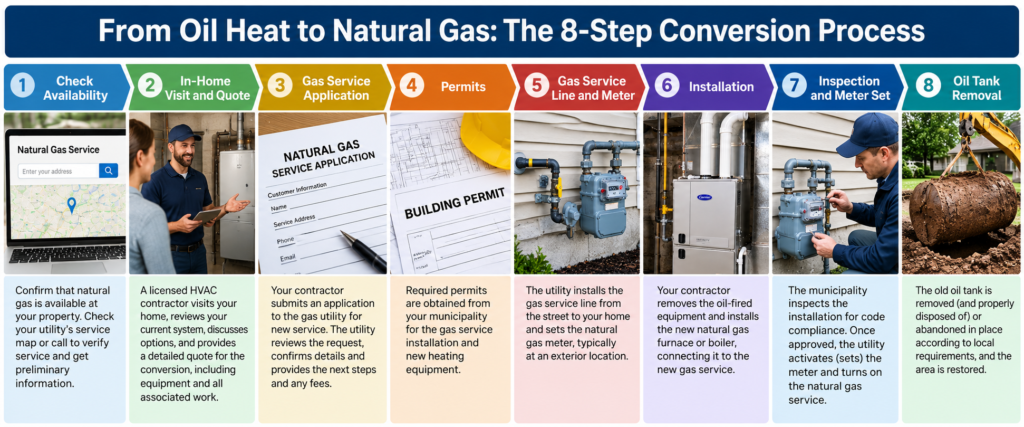
5. What Does the Conversion Process Look Like?
Here is the typical order. Timelines depend on your utility and the weather.
Step | What happens | Typical timing |
1. Check availability | You confirm gas is available at your address with the utility. | A phone call or email. A response can take a couple of business days. |
2. In-home visit and quote | We look at your current system, your home and your gas needs, and give you a flat-rate price in writing. | Usually a single visit. |
3. Gas service application | You or your contractor submit the application for gas service. The utility reviews it and tells you what is needed. | A few days to a couple of weeks. |
4. Permits | Your contractor pulls the permits for the new equipment and gas work. | Often handled while you wait for the utility. |
5. Gas service line and meter | If your home does not have service, the utility installs the line and meter. | PSE&G says new service line installs take about four to six weeks, depending on permits and weather. |
6. Installation | The new furnace or boiler goes in, gas piping and venting are completed and the old oil equipment is removed. | Typically one to a few days. |
7. Inspection and meter set | Your town and the utility inspect the work, and the meter is set. | Schedule it as installation finishes. |
8. Oil tank | The tank is drained, cleaned and removed, or closed according to the rules. | Often scheduled around the installation. |
Because the utility work is what takes the longest, start early. If your oil system is failing or your tank is aging, do not wait until the first deep freeze.
6. Is It Worth Switching From Oil to Gas? Who Should and Shouldn’t Convert
Converting often makes sense if:
- Gas is already available at your address, or a service line is free or low-cost
- Your oil furnace or boiler is 15 years old or older
- You have an aging oil tank, especially a buried one
- Your oil bills keep rising
- You want to stop scheduling oil deliveries
You may want to wait or look at other options if:
- Gas is not available on your street, or extending a main would be costly or slow
- You recently installed a high-efficiency oil system that is in good shape
- You plan to move soon and want to avoid the upfront cost
- You want cooling as well as heating from one system
Honest advice goes both ways. If gas is not a good fit for your home, we will tell you.
3 South Jersey Locations to Serve You
Berlin , NJ
Williamstown , NJ
Trenton , NJ
Not Ready for Gas? Consider a Heat Pump
If gas is not available, or you would rather not use fossil fuels at all, a heat pump can replace your oil system and also cool your home. Cold-climate heat pumps work in South Jersey winters, and New Jersey rebates for converting off fossil fuel heat can be larger than the rebates for gas equipment. Read our guide to replacing oil heat with a heat pump in New Jersey, or compare the two in Heat Pump vs. Gas Furnace in South Jersey. A free estimate will price both so you can compare.
Get Your Free In-Home Estimate for an Oil-to-Gas Conversion
Call us and we will check your home, explain your options and give you a flat-rate price before any work begins.
Professor Gatsby’s converts oil heating systems for homeowners in Gloucester, Camden and Burlington Counties, including Audubon, Berlin, Cherry Hill, Williamstown, Mount Laurel, Marlton and nearby towns.
- Free in-home estimate
- Flat-rate pricing quoted before work starts
- Honest advice on gas, a heat pump or both
- 2,800+ five-star reviews
- Phones answered and fast response, 7 days a week
Call (856) 210-8758 or request your free estimate online.
Oil to Gas Conversion FAQ
How much does it cost to convert from oil to gas?
Most conversions fall between about $8,000 and $20,000, depending on whether you choose a furnace or a boiler, how far the gas line must run and how complex the installation is. Oil tank removal and any gas service line charges are additional. A free in-home estimate gives you an exact price.
Is it worth switching from oil to gas?
Often, yes, when gas is available. Gas typically costs 30 to 50 percent less to run than oil, and you avoid oil deliveries and an aging oil tank. Payback commonly runs somewhere between 5 and 10 years, and higher oil prices shorten it.
How do I know if gas is available at my house?
Check for a gas meter on your home or ask neighbors. Then call your gas utility, such as South Jersey Gas at 1-888-637-2854, or email PSE&G at switchtogas@pseg.com. Availability depends on how close your home is to a gas main.
Who removes the oil tank?
Above-ground tanks can be drained and removed by licensed professionals. Underground tank work must be done by certified contractors in New Jersey. Ask your HVAC contractor whether tank removal is included or coordinated.
How long does a conversion take?
The installation itself usually takes one to a few days. The utility work and permits take longer. PSE&G says new service line installs take about four to six weeks, depending on permits and weather. Homes that already have gas service move faster.
Is gas cheaper than oil?
In most cases, yes. Natural gas typically costs 30 to 50 percent less than heating oil for the same home, and oil prices are expected to rise again this winter. Your savings depend on your usage and current prices.