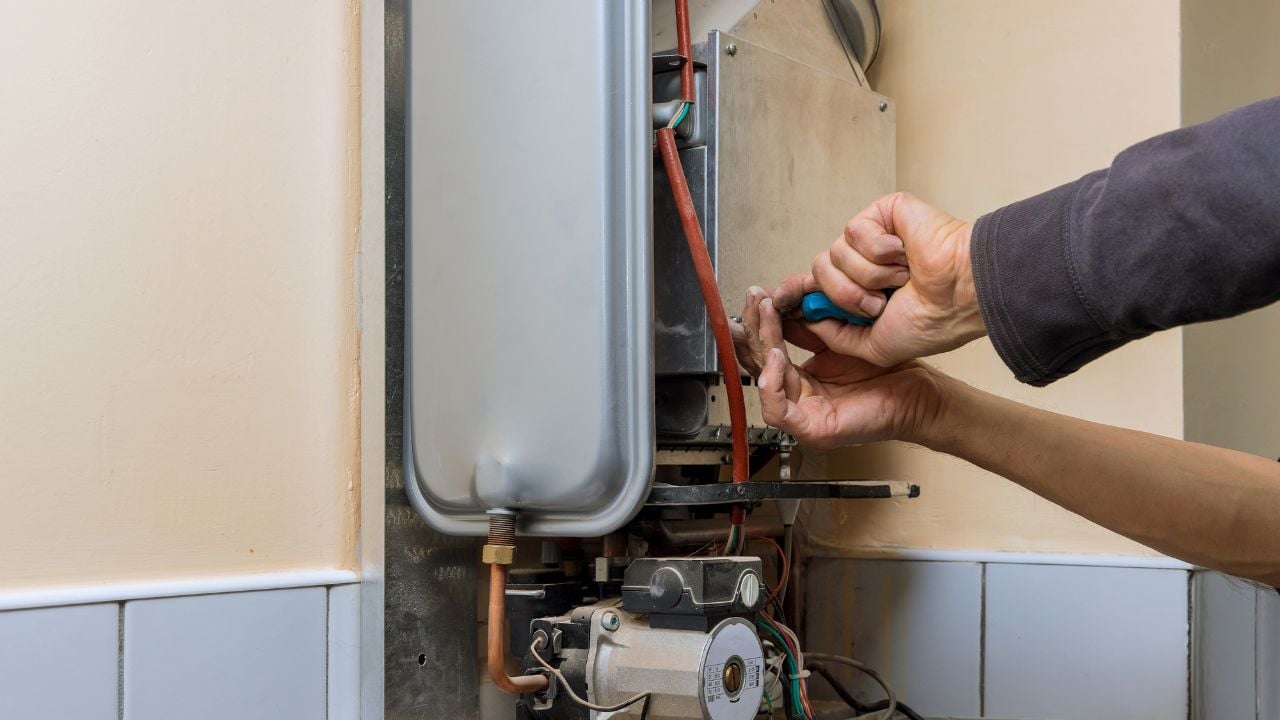
The single most common mistake homeowners make when switching to tankless isn’t choosing the wrong brand — it’s choosing the wrong size. An undersized unit means fighting for hot water the moment a second shower or the dishwasher kicks on. An oversized unit means paying more upfront and, in the case of electric models, potentially triggering an expensive electrical panel upgrade you didn’t actually need. Getting the size right is what determines whether you love your tankless system or regret the switch.
If you’re a homeowner in Egg Harbor Township, Mullica Township, or Pine Hill weighing a tankless upgrade, here’s how sizing actually works, what real brands and models look like at each size tier, and what you should realistically expect to pay — for both gas and electric.
How Tankless Sizing Actually Works
Unlike a tank water heater, which is sized by storage capacity (gallons), a tankless unit is sized by flow rate — how many gallons per minute (GPM) it can heat continuously — combined with temperature rise, which is how many degrees the unit needs to raise the incoming water temperature to reach your desired output.
Temperature rise matters more in South Jersey than sizing guides written for warmer climates suggest. Groundwater here runs cold in the winter — often in the 40s°F — meaning a unit needs to achieve roughly a 60-70°F temperature rise to deliver a comfortable 110-120°F at the tap. A unit that performs beautifully in a warm-climate sizing example may deliver noticeably less usable flow once winter groundwater hits it here.
The basic method: add up the flow rate of every fixture likely to run at the same time during your household’s busiest moment, then size a unit that can hit that combined GPM at your winter temperature rise.
Typical fixture flow rates:
- Shower: 2.0–2.5 GPM
- Kitchen sink: 1.5–2.0 GPM
- Bathroom sink: 1.0 GPM
- Dishwasher: ~1.5 GPM
- Washing machine (hot cycle): ~1.5–2.0 GPM
Two showers running at once, for example, already puts you at 4-5 GPM before anyone touches a faucet.
Sizing by Household — Quick Reference
Household | Typical Peak Demand | Gas Unit Size | Electric Unit Size |
1–2 people, 1 bath | 2.5–4 GPM | ~150,000 BTU | 18–24 kW |
2–3 people, 2 baths | 4–6 GPM | 150,000–180,000 BTU | 24–27 kW |
Family of 4, 2.5 baths | 5–7 GPM | 180,000–199,000 BTU | 27–36 kW |
Larger home, 3+ baths | 7–11 GPM | 199,000 BTU (may need 2 units) | Electric often impractical at this tier |
For larger South Jersey homes needing 9+ GPM in winter, electric tankless becomes a hard sell — even a top-tier 36 kW electric unit tops out around 7 GPM under cold-climate conditions, and simultaneous high-demand use (two showers plus a dishwasher) is where electric units in this climate genuinely struggle. Gas is almost always the more realistic whole-home option for larger South Jersey households; electric tends to make the most sense for smaller households, point-of-use applications, or homes without gas service at all.
Gas Tankless: Brands, Models, and Sizes
Gas tankless dominates the whole-home market, and for good reason — higher flow rates and better cold-climate performance than electric.
Brand | Model Tier | Approx. Flow Rate | Unit Price Range |
Rinnai | RL75i | ~7.5 GPM | $900–$1,400 |
Rinnai | RL94i | ~9.4 GPM | $1,200–$1,700 |
Rinnai | RU199iN | Up to ~11 GPM (199,000 BTU) | $1,500–$1,995 |
Navien | NPE-180A2 | ~7.5 GPM | $1,075–$1,500 |
Navien | NPE-210A2 | ~8.6 GPM | $1,300–$1,900 |
Navien | NPE-240A2 | ~11.2 GPM | $1,800–$2,500 |
Rheem | Performance Platinum series | ~7–9 GPM | $670–$1,500 |
Rheem | RTGH condensing series | ~9–11 GPM | $1,200–$1,950 |
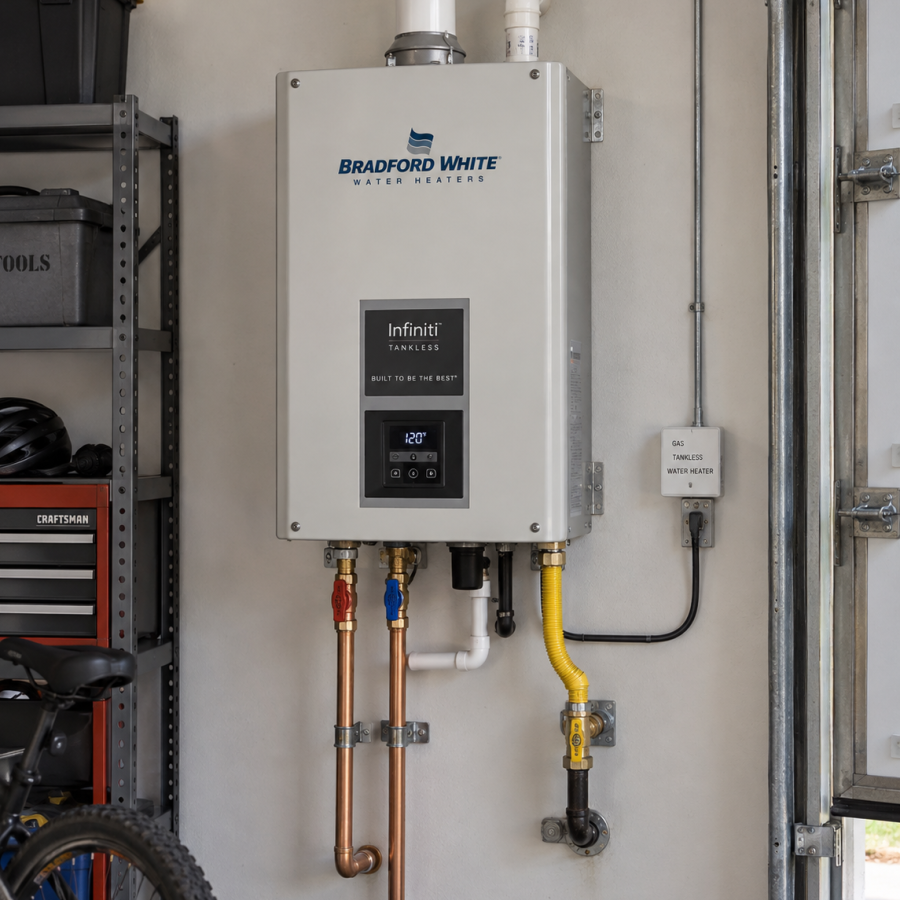
Bradford White | Infiniti series | ~7–10 GPM | $1,000–$1,500 |
Noritz | NR series | 9–11+ GPM (commercial-capable) | $1,300–$2,200 |
A note on brand differences: the equipment price gap between these brands is generally a few hundred dollars at most — the bigger cost driver is almost always your home’s specific venting and gas line situation, not which nameplate is on the unit. Rinnai and Navien dominate residential installs and both have strong service-network availability; Noritz is worth considering specifically if your household’s peak demand pushes toward the 11+ GPM range, since it’s built to handle higher-flow and multi-bathroom scenarios other brands sometimes require two units for.
Electric Tankless: Brands, Models, and Sizes
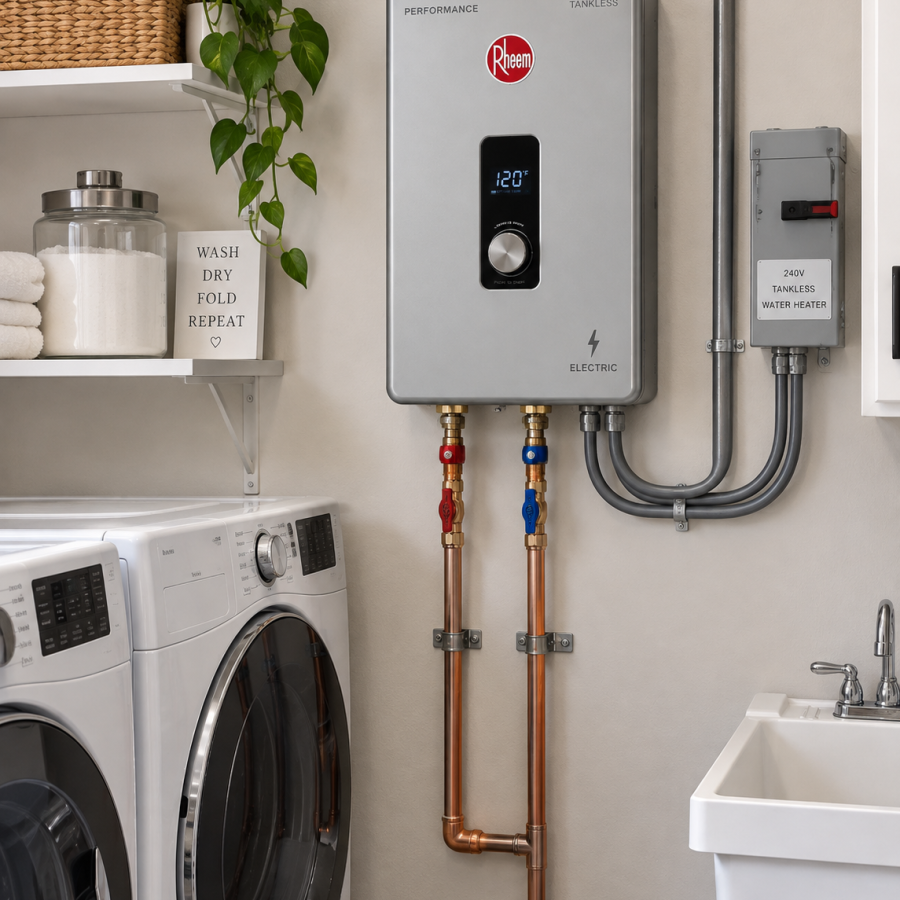
Electric tankless makes the most sense for smaller households, homes without gas service, or as a point-of-use solution for a single fixture rather than whole-home coverage.
Point-of-use (single fixture) models:
Brand | Model | Output | Unit Price Range |
Rheem | RTEX-08 | 8 kW | $180–$250 |
Rheem | RTEX-06T | 6.5 kW | $150–$220 |
Rheem | RTEX-13 | 13 kW | $250–$300 |
EcoSmart | ECO 11 | 13 kW | $200–$280 |
Stiebel Eltron | Tempra 12 Plus | 12 kW | $350–$450 |
Bosch | Tronic 3000T | 7.2 kW | $200–$280 |
Whole-home models:
Brand | Model | Output | Approx. Flow Rate | Unit Price Range |
Rheem | RTEX-24 | 24 kW | ~4.1 GPM (moderate climate) | $400–$550 |
Rheem | RTEX-36 | 36 kW | ~6–7 GPM | $500–$700 |
EcoSmart | ECO 27 | 27 kW | ~4–5 GPM | $400–$500 |
Stiebel Eltron | Tempra 29 Plus | 29 kW | ~5 GPM | $500–$650 |
Stiebel Eltron | Tempra 36 Plus | 36 kW | ~7 GPM | $650–$850 |
The electrical panel is the real constraint, not the unit itself. A 36 kW whole-home electric unit typically needs roughly 150 dedicated amps at 240V — more available capacity than most panels installed before 2000 have to spare. If your panel is older or already near capacity, budget for a panel upgrade as a real possibility, not an edge case, before committing to whole-home electric tankless.
Installed Cost: Unit + Labor
This is where the real budgeting happens, since the unit itself is typically only 30-50% of the total installed cost.
Gas tankless — typical installed totals:
- Basic swap (existing gas line and venting adequate, 1-2 bath home): $1,800–$3,200
- Moderate complexity (some venting or gas line work, 2-3 bath home): $3,000–$4,800
- Larger home, extended venting, gas line upgrade: $5,500–$8,000
Labor alone typically runs $600–$2,500, with installs taking roughly 6-14 hours depending on venting complexity and whether the gas line needs to be upsized. A 199,000 BTU unit often requires a minimum 3/4-inch gas line for short runs, and a full 1-inch line on longer runs to maintain proper pressure — this is one of the most common reasons a gas tankless quote comes in higher than expected.
Electric tankless — typical installed totals:
- No panel upgrade needed: $800–$1,500
- With a panel upgrade: $1,500–$5,500+, since the panel upgrade itself commonly runs $1,500–$4,000 on top of the unit and base labor
Electric installs are generally faster and less invasive than gas — no venting to run — but the panel question needs to be answered before the total cost is really knowable.
A Note on 2026 Incentives
The federal 25C tax credit that used to offset qualifying tankless installs (up to $600 for high-efficiency gas units) expired for installs after December 31, 2025. For 2026 installs, the remaining incentive pathways are state and utility rebates and the income-qualified IRA HEAR program (point-of-sale rebates up to $1,750 for qualifying electric water heaters) — worth asking about during your quote, since availability and amounts vary by program and household income.
The Pain Point: Undersizing Is an Expensive Mistake to Discover Later
Here’s what makes sizing worth getting right the first time: an undersized tankless unit doesn’t fail outright — it just quietly disappoints every single day, delivering lukewarm water the moment two people need hot water at once. Many homeowners live with this for months, assuming it’s just how tankless works, before learning the unit was simply undersized for their household’s actual peak demand. Correcting that after the fact means paying for a second, larger unit — essentially paying for the sizing mistake twice. A proper load calculation before installation, accounting for South Jersey’s winter groundwater temperatures specifically, is a small step that prevents a genuinely expensive one.
Related Reading
If you’re still deciding whether tankless is the right move at all, our guides on tankless vs. traditional water heaters, what to check before switching to tankless, and Rinnai vs. Navien lifespan and warranty cover the broader decision. Once installed, our guide to tankless water heater descaling maintenance explains the upkeep that protects your investment long-term.
Let Professor Gatsby’s Size It Right the First Time
Sizing a tankless water heater correctly means accounting for your specific household’s peak demand, your home’s existing gas line or electrical capacity, and South Jersey’s winter groundwater conditions — not just picking a popular model off a list. Our licensed technicians serve homeowners throughout Egg Harbor Township, Mullica Township, Glenloch, and the surrounding South Jersey area, and we’ll calculate your home’s actual load before recommending a brand, model, or fuel type.
Ready to go tankless the right way? Contact Professor Gatsby’s or book an appointment online for an accurate sizing assessment and a straightforward installed quote.
3 South Jersey Locations to Serve You